“Howl” is a modernistic poem using the Beat Generation's lack
of formal punctuation and ideals of rejecting conventional society, sex, drugs and Jazz. Semi-autobiographical in nature,
“Howl” explores who the “best minds” (9) of his generation are (were)
and the impact that they had on his life and for a brief time the entire nation.
Part I:
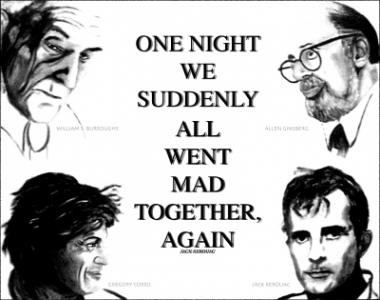 This part has seemingly no cohesiveness to it and jumps
around the United States, and parts of the world as well, (referencing several
times Golgotha and Tangiers), all while talking about how “they” act in public
and are the best minds. Originally
I thought it was the “Lost Generation” of World War I, then I saw it’s
publication and thought it was maybe from World War II or even the Korean
Conflict. Then I learned of the
Beat Movement and still hold to my belief that the best minds were Ginsberg’s
friends, i.e. Neal Cassidy, Carl Solomon, Jack Kerouac and Herbert Huncke. I thought/think this because Cassidy
was known to travel cross country on whim and most of the cities referenced in
the poem Cassidy at one time or another visited. The poem also exemplifies the Beat Generation’s view’s on
life, sex and drugs. So this poem
is about everyone who uses drugs to gain that extrasensory vision as being the
best minds that Ginsberg refers to as well.
This part has seemingly no cohesiveness to it and jumps
around the United States, and parts of the world as well, (referencing several
times Golgotha and Tangiers), all while talking about how “they” act in public
and are the best minds. Originally
I thought it was the “Lost Generation” of World War I, then I saw it’s
publication and thought it was maybe from World War II or even the Korean
Conflict. Then I learned of the
Beat Movement and still hold to my belief that the best minds were Ginsberg’s
friends, i.e. Neal Cassidy, Carl Solomon, Jack Kerouac and Herbert Huncke. I thought/think this because Cassidy
was known to travel cross country on whim and most of the cities referenced in
the poem Cassidy at one time or another visited. The poem also exemplifies the Beat Generation’s view’s on
life, sex and drugs. So this poem
is about everyone who uses drugs to gain that extrasensory vision as being the
best minds that Ginsberg refers to as well.
Part II:
 Ginsberg evokes Moloch in this section as a way to personify
a fictional deity and explain the strange turn American life took around the
time of the publication. To
Ginsberg, conformity was the epitome of self-identity loss, “What sphinx of
cement and aluminum based open their skulls and at up their brains and imagination?”
(21.) The sphinx he is referring to are the factories and corporations that
were springing up across America and the shift from praying to other fictional
deities to the “gods” on the floors above you that controlled the fate of you
and your job. Also, here Ginsberg
is still referencing the best minds as apparent by the use of the world “their”
and the lack of introducing other characters. Ginsberg seems to see Moloch as everything changing for the
sole purpose of satiating Moloch’s thirst for blood and its need to consume
those who fail to do what they are told.
Ginsberg evokes Moloch in this section as a way to personify
a fictional deity and explain the strange turn American life took around the
time of the publication. To
Ginsberg, conformity was the epitome of self-identity loss, “What sphinx of
cement and aluminum based open their skulls and at up their brains and imagination?”
(21.) The sphinx he is referring to are the factories and corporations that
were springing up across America and the shift from praying to other fictional
deities to the “gods” on the floors above you that controlled the fate of you
and your job. Also, here Ginsberg
is still referencing the best minds as apparent by the use of the world “their”
and the lack of introducing other characters. Ginsberg seems to see Moloch as everything changing for the
sole purpose of satiating Moloch’s thirst for blood and its need to consume
those who fail to do what they are told.
Part III:

This part seems to be an ode to Ginsberg’s friend, Carl
Solomon, as well as his own mother who also was institutionalized numerous
times when he was younger.
Repeated throughout are the words “I’m with you in Rockland” meaning
that while Ginsberg is not physically with Solomon in the asylum, he is with
Solomon ins spirit and feeling, having felt the same way as Solomon does (or
must feel) while at Rockland. I
think that the entire poem leads up to this conclusion with, who I perceive to
be one of the best minds that Ginsberg speaks of in part one, Solomon ending up
in a mental institution having not found the angels he was looking for with his
narcotic and losing the battle between Moloch and his self-identity. It’s not just Carl Solomon in Rockland
or institutions similar to that, but “twenty five thousand mad comrades” (25)
who have also lost the same war that Ginsberg and others like him fought and
won, or staved off defeat for the time being.

No comments:
Post a Comment