Friday, June 14, 2013

Ties that Bind


Alison is not sad that her father is dead: she is instead happy about the fact that her father no longer looms over her family and herself as a domineering figure of callousness.

Throughout the entire graphic novel, Bruce acts coldly towards his family and intimidates them through violence or threat of so.  When Alison receives word that her father has died she, “cried quite genuinely for about two minutes.  That was all” (46.)  His (Bruce’s) legacy died with him and that is why Alison is not sad, but relieved when she learns of his death.  She now has the opportunity to move on with her life and not live under the shadow of her father’s will and presence.

http://rpmedia.ask.com/ts?u=/wikipedia/en/thumb/c/ce/Little_miss_sunbeam_logo.jpg/220px-Little_miss_sunbeam_logo.jpgFrom and early age, Bruce imposed his will upon Alice and her family to do what he wants.  Most notably, he for all intents and purposes forced Alison to dress like a girl when she was growing up.  Never allowing her to express herself for who she wanted to be and always suppressing any desire or urge to be something other than what he wanted her to be: normal.  Or rather the appearance of being normal, like the façade that he wears around.  On page 15, Bruce forced Alison to change her clothes so that the “necklines match” and on page 118 after seeing the “bulldyke” Bruce condescendingly asks Alison, “ Is THAT what you want to look like?”  He simply refused the notion of allowing his daughter to be whom she chose to be and not what was demanded of her from society or from him.

http://www.glamquotes.com/wp-content/uploads/2011/11/smile.jpgThe moment when Alice sees her younger brother, John, they break into uncontrollable smiles.  Not because they hated their father, but because they know that the implications of his death meant for them and for their family: the oppressive atmosphere at the house would be no more.  They didn’t smile out of malice or disrespect towards their father, it was the realization of what lay ahead of them that caused their “ghastly, uncontrollable grins” (46)

http://coconutheadsets.com/wp-content/uploads/2009/12/sisyphus.jpgBruce was a representation of many things, hatred towards oneself, tyrannical behavior and projecting his faults on the children--most notably Alice.  It wasn’t until Alice moved out of her parent’s house and went to college did she finally grow into her own skin and was able to fulfill her ideal self-image.  None of that could have been accomplished if she had continued living with her parents and with her father.  His death metaphorically set Alice free from the chains that bonded her to him and his will.  Though he is gone, Alice will have to live with the implications that he left behind as his legacy and come to grips with who he was and what he did.

Thursday, June 6, 2013

Chasing the Dream


The one thing that as a society we don’t want to think about, and one of the pervasive themes in “Negocios”, is the truth behind the “American Dream.”  The broken lives the majority of the immigrants have and must endure in order to marginally improve their conditions in America.

When Ramon left his home on the Dominican Republic, he had a dream of making a better life for himself, the prototypical dream most, if not everyone, wants in life.  However, what he was not expecting were the conditions and the hardships that he would have to endure in order to partially realize that dream.  He has a naive notion of life in Americahaving supposedly said, “I got two hands and a heart as strong as rock.”  Because Ramon had no plan, and because Ramon had a very limited idea of what the “American Dream” entailed, thanks, in so small part, to the media who only focus on how one has, or can, increase their life to the point of being in the lower-middle-class. 

 Ramon’s optimistic point of view is slightly shattered one morning when, during his morning routine of push-ups, the cleaning lady responds to him with, “If you had a job, you wouldn’t need exercise.”  This only shows how shattered this woman is after potentially chasing after her own American Dream and failing, miserably.  Ramon is undeterred and quickly finds a job.  But it’s not enough; it’s never enough in the land of opportunity.  Ramon has to share a, from what we can assume, two bedroom apartment, with three other men and is forced to sleep on the floor then on a mat on the floor.  

The only time Ramon improves his condition is when he practically has to force himself on Nilda and moves in.  This, however, is after walking the majority of the way from Virginia to New York, “He walked in his bad shoes, froze....” and after working for 18-20 a day just to be able to pay for rent and the basic necessities for living-- anywhere.  But somehow, miraculously Ramon still holds tight to the idealized notion that America is the land of opportunity and that it’s the only place anyone can improve their condition in life.  Even after having to endure hardships that no one should ever have to bear, and being scammed our of $800, he’s still so positive about being able to attain his dream of a better life.

However, when stories like his are reported on the evening news, none of this is mentioned or brought up.  All that is focused on is how one person with a dream overcame “adversity and hardship” to reach a new standard of living; usually lower-middle class.  This is not the case with Ramon, he’s one of the few exceptions to that generalization.  He uses Nilda as a means to an end in order to rise in the socio-economic ladder, “Within a month Papi moved out of his appartment into her house in Brooklyn.  They were married in March.  ...He lived in Nilda’s house, shared her bed, paid no rent...”  

Diaz ultimately shows the story of the broken individuals that comprise the American Dream and shares with us one story, no matter how unreliable it may be or seem.

Friday, May 31, 2013

Broken Hereos


http://g2.img-dpreview.com/CFEF203E98DC4C89945FC6ADCB43F035.jpg“Only one car an hour passes by (the intersection.) (48)” This small passage could be a metaphor for once a generation a new, emerging, hero appears and could “make it all the way (47).”  What Adrian and Victor mean is that Julius or, at the end of the story, Lucy will make if off the reservation and go to college or the professionals to play basketball.   And because Adrian and Victor don’t see a car passing the intersection and the light in more than a year, that is representative of not finding a hero.

The entire story is predicated on heroes past present and future and the curious power they hold for the Native Americans of the reservation.  Victor says as much in the story on page 45, “Julius Windmaker was the latest in a long line of reservation basketball heroes.”  Because Julius is the most recent incarnation of a basketball hero, he carries the weight of the entire reservation on his shoulders-- a tall order for a boy of only 15.  With that burden of responsibility also comes the urge to be a normal teenager and cause mischief with his friends and forgo his potential future as a college or professional basketball player.  Eventually, some would say it was inevitable; Julius detracts from his path and sinks into alcoholism fads into obscurity faster than he came onto the scene.

Michael Jordan Dunk Michael Jordan Turns 50 Years Old And He Still Earns $80 Million Dollars YearThe past heroes of the reservation include Victor himself and Silas Sirius, who, despite only playing one game, still captivates the minds and imaginations of everyone on the reservation.  Though Victor admits to never being as good as Julius or Silas, “But I used to be a good ball player.  Maybe not as good as some, certainly not as good as Julius…. (46)” he nevertheless was a local hero for a short time.  Silas, on the other hand, only played for one game, less than that, and he is still talked about with reverence.

http://www.sports4kids.com/v/vspfiles/photos/TWK1460-2T.jpgNear the end of the story, Victor and Adrian go to see Julius play after seeing him “drunk as a skunk (50)” at two in the afternoon.  The memories of seeing him play soon faded, “everyone told their favorite Julius Windmaker… (51)” and the collective thoughts of the reservation turned to little third grader Lucy.  In the time that Adrian and Victor saw that the stoplight was out to seeing Julius stumbling down the road drunk, there is not one mention of a car passing by.  This represents the rise, short-lived fame and eventual fall of heroes as they come up through the levels of basketball.  Because the stoplight breaks and is not repaired and because no cars pass the intersection, it can be interpreted that none of the reservation heroes will make it all the way and leave the reservation.

Friday, May 24, 2013

Beatnik

 
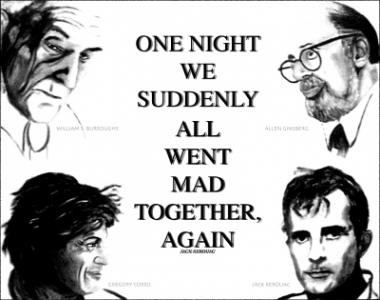
“Howl” is a modernistic poem using the Beat Generation's lack of formal punctuation and ideals of rejecting conventional society, sex, drugs and Jazz.  Semi-autobiographical in nature,  “Howl” explores who the “best minds” (9) of his generation are (were) and the impact that they had on his life and for a brief time the entire nation.

Part I:
http://images.fineartamerica.com/images-medium/the-beat-generation-jude-rouslin-a4608.jpgThis part has seemingly no cohesiveness to it and jumps around the United States, and parts of the world as well, (referencing several times Golgotha and Tangiers), all while talking about how “they” act in public and are the best minds.  Originally I thought it was the “Lost Generation” of World War I, then I saw it’s publication and thought it was maybe from World War II or even the Korean Conflict.  Then I learned of the Beat Movement and still hold to my belief that the best minds were Ginsberg’s friends, i.e. Neal Cassidy, Carl Solomon, Jack Kerouac and Herbert Huncke.  I thought/think this because Cassidy was known to travel cross country on whim and most of the cities referenced in the poem Cassidy at one time or another visited.  The poem also exemplifies the Beat Generation’s view’s on life, sex and drugs.  So this poem is about everyone who uses drugs to gain that extrasensory vision as being the best minds that Ginsberg refers to as well.

Part II:
http://mikeaustin.org/AAA/May%2015/moloch.jpgGinsberg evokes Moloch in this section as a way to personify a fictional deity and explain the strange turn American life took around the time of the publication.  To Ginsberg, conformity was the epitome of self-identity loss, “What sphinx of cement and aluminum based open their skulls and at up their brains and imagination?” (21.) The sphinx he is referring to are the factories and corporations that were springing up across America and the shift from praying to other fictional deities to the “gods” on the floors above you that controlled the fate of you and your job.  Also, here Ginsberg is still referencing the best minds as apparent by the use of the world “their” and the lack of introducing other characters.  Ginsberg seems to see Moloch as everything changing for the sole purpose of satiating Moloch’s thirst for blood and its need to consume those who fail to do what they are told.

Part III:
http://derrames.files.wordpress.com/2008/11/5840_insane_man_in_a_strait_jacket_and_padded_room1.jpg
This part seems to be an ode to Ginsberg’s friend, Carl Solomon, as well as his own mother who also was institutionalized numerous times when he was younger.  Repeated throughout are the words “I’m with you in Rockland” meaning that while Ginsberg is not physically with Solomon in the asylum, he is with Solomon ins spirit and feeling, having felt the same way as Solomon does (or must feel) while at Rockland.  I think that the entire poem leads up to this conclusion with, who I perceive to be one of the best minds that Ginsberg speaks of in part one, Solomon ending up in a mental institution having not found the angels he was looking for with his narcotic and losing the battle between Moloch and his self-identity.  It’s not just Carl Solomon in Rockland or institutions similar to that, but “twenty five thousand mad comrades” (25) who have also lost the same war that Ginsberg and others like him fought and won, or staved off defeat for the time being.

Friday, May 17, 2013

The Piano Lesson

Boy Willie is arguably the most dynamic character in the play "The Piano Lesson."  However, it takes almost the entire play to fully realize his potential and to get a better understanding of his motivations and reasons for his actions.  Boy Willie is also a character that seems to talk a lot with nothing to say.  Given the amount of talking he does, most of it is just repetitive and doesn’t add anything to the plot or to the conversation that is being had.  That changes at the end where has has five monologues within the span of six pages (88-93.) I would argue to call him a sociopath, though one cannot come to that conclusion until the end of the play after learning more of Boy Willie’s past.

The first half of the play includes Boy Willie explaining his plan of “1/3’s” and getting the old Sutter farm.  That’s about all he talks about for the majority of the play.  He is so singular in his plan that that’s all he can think and talk about to anyone; especially his sister Berniece.  He also believes whole-heartedly that his 1/3 plan will work out and that he’ll be able to both get rid of the piano and get his revenge by owning the Sutter farm; and get rid of Sutter’s ghost from Doaker’s house in the process.  Boy Willie says as much, “He (Sutter) had to die to find out where that piano was at....If I was you I’d get rid of it.  That’s the way to get rid of Sutter’s ghost.  Get rid of that piano” (Wilson 17.) 

That part also show’s Boy Willie’s concern for his family, as well as making some money off of the piano.  However, that concern is quickly done away with as he continues to ramble on about his plan and how he’s got “..One part of it.  Sell them watermelons and get me another part.  Get Berniece to sell that piano and I’ll have the third part” (Wilson 9.)  

The most drastic change to Boy Willie’s character happens at the end of the play where he, not only defends himself and his plan but also gives the reader/audience a glimpse into his past and his reasons for doing what he is doing.  This is also where he contributes the most to the conversation as well as advances the plot to the climax, and reveals that he fully believes in what he is doing and that he is int he right to do what he’s been doing then entirety of the play.  We find that Boy Willie has no fear of death, he killed a cat to recognize his “power” and probably admitted to killing Sutter.  He changes from the beginning; a mildly annoying man-child that only talks about his plan and nothing much else to being a man who stands up for himself, defends his actions and fights a ghost.